
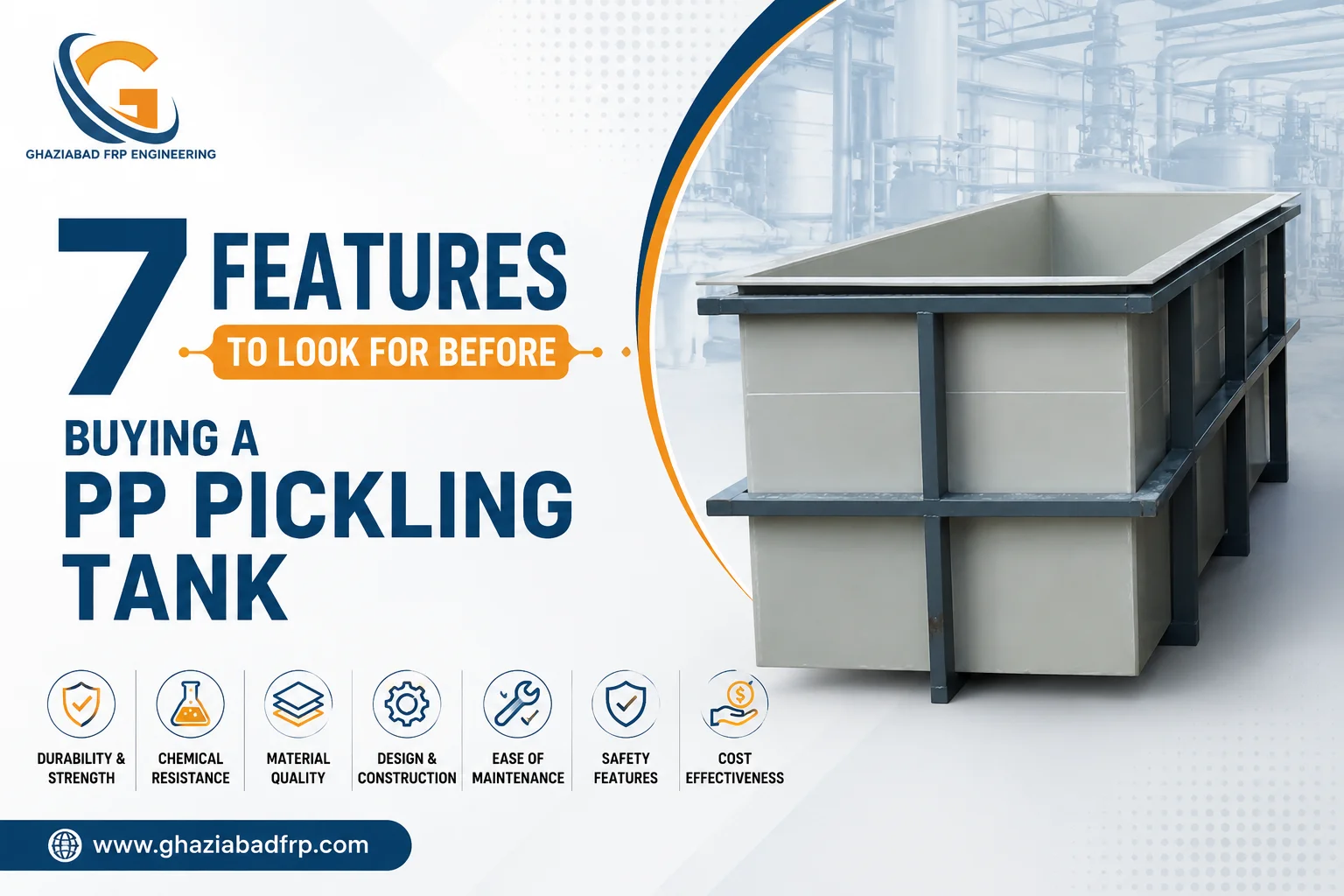
Industrial pickling tanks are crucial equipment used by various enterprises for a range of purposes. In fact, whether industries manufacture steel parts, galvanised goods, pipelines, or other metal products, these tanks cannot be replaced by anything else. Nonetheless, simply relying on tank dimensions or price can lead to numerous issues in the future, such as leaks, chemical damage, excessive maintenance, and downtime.
Therefore, industries should assess certain performance aspects before acquiring new equipment. Not every tank offered by PP pickling tank manufacturers provides equally impressive performance indicators. Below are the key features industries should consider while shopping.
Key Features to Evaluate Before Choosing a PP Pickling Tank.
Chemical Resistance Properties
As previously mentioned, tanks usually contain different acids and corrosive agents which can harm equipment made of materials unsuitable for chemical interaction. Polypropylene tanks resist many chemicals well; however, this does not mean that any tank performs similarly. For instance, the concentration of chemicals, operating temperature, and exposure time should be considered when buying new tanks.
Industries should check if their tanks are able to function with specific concentrations of acids and chemicals. Moreover, several manufacturers specialising in selling PP Pickling Tanks usually assist customers in this procedure.
Tank Structure and Thickness
The strength of tanks is crucial since thin structures tend to wear out much faster. Some of the benefits of thick tanks include:
- Improved ability to carry loads
- Decreased probability of bending
- Enhanced resistance to pressure and impacts
- Minimal risks of leaks
- Increased durability
Operating tanks under harsh conditions requires reinforced structures or the tank will inevitably wear out fast and need maintenance.
Therefore, when looking for suitable pickling tanks, pay attention to wall thickness and structure reinforcement techniques.
Tank Capacity and Dimensions
Tank size directly correlates with productivity. On the one hand, small tanks can negatively affect the process. Workers will have to spend extra time to pickle products multiple times, leading to decreased efficiency and increased operational hours.
On the other hand, large tanks increase operational expenses associated with higher chemical consumption, usage of more floorspace, higher maintenance costs and operational expenditure.
Consequently, select a tank according to your production requirements.
In particular, the following table outlines recommended tank sizes depending on production volumes.
| Production Scale | Suggested Tank Size |
| Small enterprises | Small standard tanks |
| Medium-sized factories | Medium custom-sized tanks |
| Large manufacturing facilities | Large custom tanks |
Note that some of the PP Pickling Tank Manufacturers propose custom-made tanks to match industries’ requirements.
Heat Resistance
Certain industries use pickling tanks to work with metals heated up to higher temperatures. This means that tanks should be capable of functioning properly at a certain temperature.
Otherwise, temperature influence can result in:
- Metal bending
- Structure weakening
- Reduced durability
- Joint stresses
- Changes in tank shape
Polypropylene is known for its excellent temperature properties, but still, industries should check the maximum temperature limit for each tank.
Joint and Weld Quality
Even though polypropylene tanks resist various negative factors, they can still break down and develop leaks due to low-quality joints.
Tanks are more likely to develop defects in joints because they experience a lot of pressure and are subjected to chemical interactions. Therefore, you should inspect the quality of tank joints.
Some aspects to keep in mind are uniform appearance of welds, consistency of welded areas, quality of reinforcements of joints, testing for leaks and manufacturing standards.
Safety Features and Accessory Fittings
Industrial equipment should not only increase efficiency. Instead, industries should prioritise workplace safety when selecting tanks. Several accessories can enhance safety during work with a tank.
Common additions to tanks include:
- Overflow outlets
- Draining equipment
- Safety covers
- Inspection devices
- Support structures
- Access platforms
- Ventilation equipment
Although some of these additional items do not seem crucial at first, they are quite convenient to install and use during work and cleaning.
Moreover, their presence ensures that employees will avoid accidents related to the use of pickling tanks. Consequently, industries can reduce maintenance costs.
Customisation from Manufacturers
Each industry works differently; thus, there is no universal pickling tank that would suit all of them perfectly. To make tanks work more efficiently, industries should consider customised solutions. Some of the common customisations include specially-designed dimensions, additional tanks, custom fittings, agitation capabilities, reinforced structure and special outlets.
Many businesses prefer to buy custom tanks to increase operational efficiency. Many companies specialising in manufacturing PP Pickling Tanks offer customers custom-made tanks which meet their exact requirements.
Quick Feature Evaluation Checklist
| Feature | Description |
| Chemical resistance | resistance to chemical reactions and corrosion |
| Structural strength | resistance to mechanical impacts and pressure |
| Tank capacity | tank dimensions and ability to accommodate industrial requirements |
| Heat resistance | ability to work under certain temperature limits |
| Joint and weld quality | joint durability and leak-proofness |
| Safety fittings | Safety equipment added to improve the convenience of use |
| Customisation | special tank modifications for better performance |
Conclusion
Buying a tank involves assessing more aspects than size and price. The reliability of equipment depends on factors such as material compatibility, quality, and additional elements that are necessary to install. A properly chosen tank can significantly contribute to increasing efficiency and reducing maintenance costs.
For custom-engineered industrial products, you can visit Ghaziabad FRP Engineering, where PP Pickling Tanks are provided according to your performance requirements.